Mid Fade vs Low Fade: Which Fade Haircut Is Right for You?
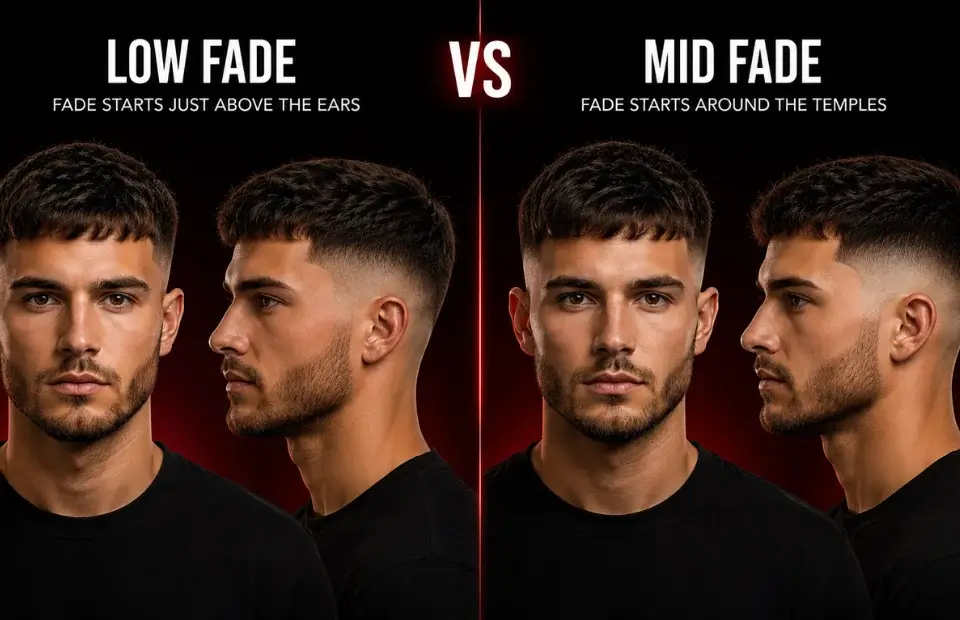
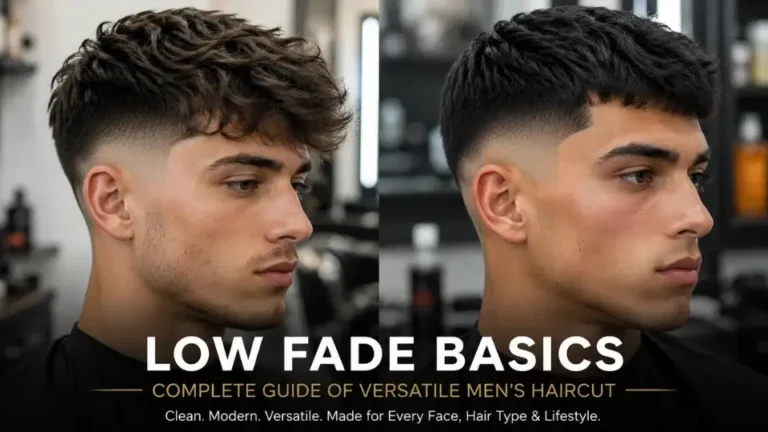
Mid fade vs low fade comes down to how much of the sides you want blended. A low fade starts just above the ears for a subtle, clean look, while a mid fade begins around the temples to create a bolder, higher-contrast style.
Both are timeless barbershop favorites in 2026 and suit different face shapes, hair types, and personal preferences. This guide explains the key differences, who each style suits best, and how to ask your barber for the exact haircut you want.
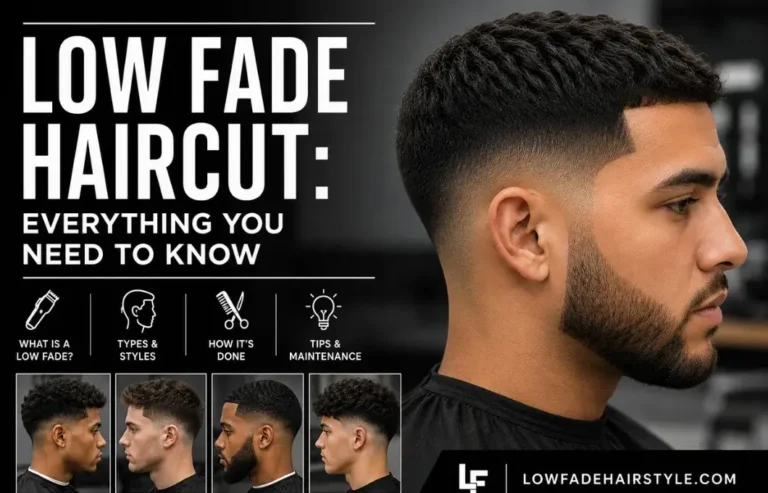
What Is a Low Fade Haircut?
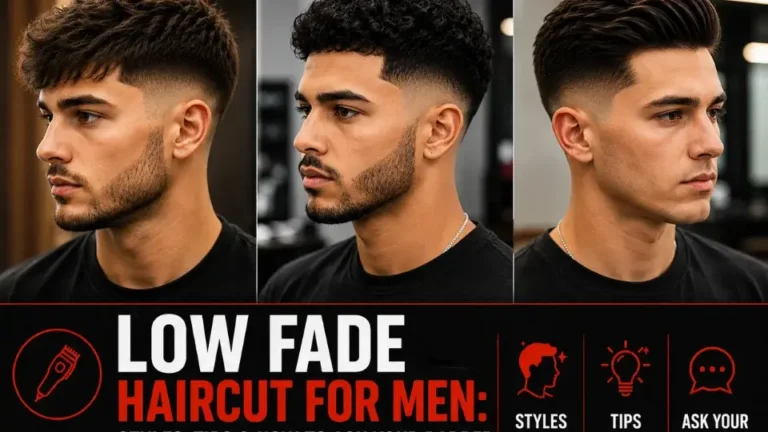
A low fade haircut starts just above the ears and neck, blending into longer hair on top. The low placement keeps it subtle — a safe, clean choice for workplaces or anyone avoiding dramatic contrast.
Key Traits of a Low Fade:
Placement: Starts low, near the earline and nape of the neck
Contrast: Minimal to moderate—more length is preserved overall
Best for: Thicker hair, professional settings, first-time fade wearers
Common pairings: Low fade with a beard, low fade with a comb-over, and low fade with curly hair on top
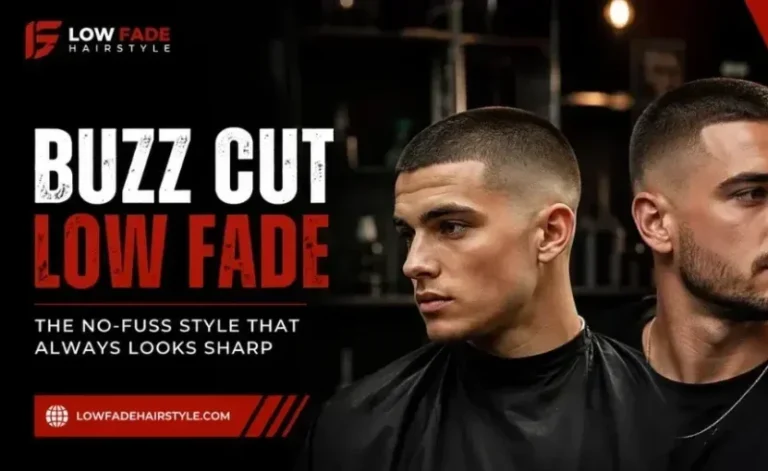
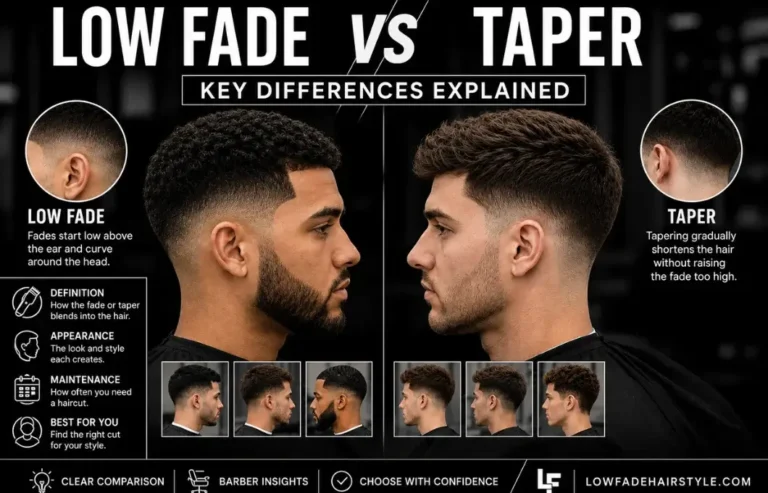
A low taper fade blends more gradually, with less contrast between guards. Barbers often use “low taper” and “low fade” interchangeably, though a true fade finishes shorter near the skin—a low skin fade or low bald fade.
What Is a Mid Fade Haircut?
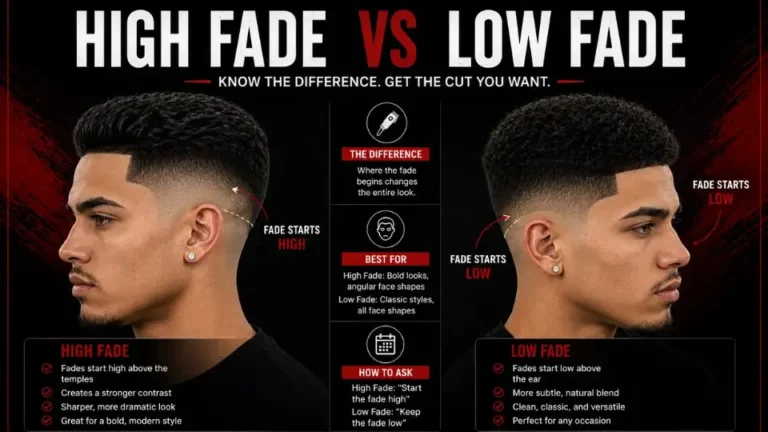
A mid fade haircut starts higher—typically around the temples, roughly midway between the ears and the top of the head. This gives more room for the fade to show, creating a bolder transition between the shaved sides and the longer top. A mid fade sits between a low fade and a high fade, offering more definition than the former while staying less extreme than the latter.
Key Traits of a Mid Fade:
Placement: Starts mid-height, around the temple area
Contrast: More visible blend, a bit more edge than a low fade
Best for: Balancing wider or rounder faces, adding shape to thinner hair
Common pairings: Mid fade with an undercut, mid fade with a textured crop, mid fade with a line up
Because the mid fade sits in the middle of the spectrum, it’s frequently the “compromise” pick for people who want more definition than a low fade but don’t want the high contrast of a high fade.
Low Fade vs Mid Fade: Key Differences
Feature |
Low Fade |
Mid Fade |
|
Fade starting point |
Near the ears/nape |
Around the temples |
|
Visual contrast |
Subtle, understated |
Moderate, more defined |
|
Best face shapes |
Long or oval faces |
Round or square faces |
|
Formality |
Very professional, low-maintenance |
Slightly bolder, still workplace-friendly |
|
Upkeep frequency |
Every 3–4 weeks |
Every 2–3 weeks |
|
Good for thick hair |
Yes |
Yes, also softens bulk |
|
Good for thin hair |
Can look flat |
Adds the illusion of volume |
If you’re weighing low fade vs mid fade vs high fade, think of it as a sliding scale of boldness: low fade is the quietest option, mid fade sits comfortably in the middle, and high fade delivers the most dramatic, sharpest contrast by starting near the crown.
Low Fade vs High Fade vs Skin Fade: Where Does Each Sit?
It helps to see the full family of fades side by side:
Low fade: Starts near the ears — subtle and low-maintenance
Mid fade: Starts at the temples—balanced contrast
High fade: Starts near the crown — bold, high contrast
Skin/bald fade: Refers to how short the fade gets (down to the skin), and can be applied at low, mid, or high placement
Drop fade: Curves downward behind the ear rather than following a straight line, and can also be combined with a low or mid placement
Burst fade: Fades in a rounded arc around the ear only, often used with fringe or curly styles
Understanding this distinction matters because a low skin fade and a mid skin fade describe two different haircuts that share the same finishing technique but start in different places.
Which Face Shape Suits Each Fade?
Round faces tend to benefit from a mid fade or high fade, since the added height and vertical contrast make the face appear longer and more angular.
Oval and long faces usually look most balanced with a low fade, which avoids adding extra height and keeps proportions even.
Square faces can wear either comfortably, though a mid fade often complements strong jawlines by drawing attention upward.
Heart-shaped faces generally do well with a low fade paired with a bit more volume on top, softening a narrower chin.
If you’re unsure, bring a front-facing photo to your barber and ask them to recommend a starting height based on your face shape — a good barber will adjust the fade line rather than applying a one-size-fits-all guard length.
Low Fade or Mid Fade for Curly Hair
Both fades work with curly hair, but the finish looks different:
A low fade with curly hair keeps more length up top, letting natural curl pattern and volume stand out while the sides stay clean and low-key.
A mid fade with curly hair creates a rounder, more sculpted silhouette, since more of the head is faded and the curls on top read as a defined “crown.”
Curl density matters too: tighter, denser curls (common in low fade black male styles and 4C hair textures) often pair beautifully with a mid fade, since the added contrast highlights curl definition. Looser waves tend to blend more naturally into a low fade.
Low Fade or Mid Fade with a Beard
Fades and beards are frequently styled together for a cohesive, groomed look:
A low fade with a beard keeps the transition subtle on both the head and the jawline, ideal for a polished, professional appearance.
A mid fade with a beard adds more shape and structure, especially when the beard is fuller, since the higher fade balances out extra facial hair volume.
Ask your barber to “connect” the fade into the beard line for a seamless transition—this is especially common with low fade and beard combinations, where barbers blend the sideburns directly into beard length.
How to Ask Your Barber for the Right Fade
Miscommunication is the number one reason people end up with the wrong fade. Use these tips to describe exactly what you want:
Name the starting point. Say “start the fade at my ear line” (low) or “start it at my temple” (mid) rather than just saying “fade.”
Specify the guard numbers. A typical low fade might use a #3 or #4 on top, blending down to a #1 or skin near the ears. A mid fade often starts a guard size shorter, higher up the head.
Bring a reference photo. Even with the right words, a photo removes ambiguity about how sharp or gradual you want the blend.
Mention any add-ons. If you also want a lineup, comb-over, textured top, or beard connection, say so before the clippers start.
Ask about maintenance. A precise fade grows out faster than a looser cut—ask how many weeks you can go before it needs a touch-up.
Maintenance, Guards, and At-Home Upkeep
Both fades require regular trims to stay sharp, since regrowth blurs the line between guard lengths fastest right at the fade zone.
Guard sizes: Most low and mid fades use a combination of guards (commonly #1–#4 on the fade, blending into a #4–#8 on top), adjusted for hair type and desired contrast.
Touch-up schedule: Low fades can often stretch to 3–4 weeks between visits since less of the head is affected by regrowth. Mid fades usually need attention every 2–3 weeks to keep the higher blend crisp.
At-home upkeep: A trimmer with adjustable guards can maintain the neckline and sideburns between full barber visits, but reshaping the actual fade line yourself is risky — uneven blending is the most common at-home mistake.
Styling products: A light matte pomade or clay works well for textured tops on both fades, while a low fade with a comb over benefits from a stronger hold product to keep the longer length in place.
Popular Low Fade and Mid Fade Styles in 2026
Trending combinations this year include:
Low taper fade with a textured crop—natural movement on top, minimal contrast on the sides
Mid fade with a curly top—bold blend paired with defined curl texture
Low fade with a hard part or lineup—a crisp part line adds structure to an otherwise subtle cut
Mid skin fade with slicked-back top—a sharp contrast with a polished, formal finish
Low fade with waves — popular for shorter top lengths styled into a 360-wave pattern
Low Fade vs Mid Fade: Which Should You Choose?
There’s no universally “better” option—the right choice depends on your face shape, hair density, and how much contrast you want:
Choose a low fade if you want a subtle, professional, low-maintenance cut that works with almost any hair type and keeps most of your natural hairline intact.
Choose a mid fade if you want more definition, extra shape for a rounder face, or a slightly bolder statement without going as dramatic as a high fade.
Both are versatile enough to pair with a beard, curly or straight hair, a lineup, or a comb-over—the real difference is simply where the blend begins and how much contrast you’re comfortable maintaining between barber visits.
A Brief History of the Fade Haircut
Fade haircuts trace back to military barbering traditions, where sharply blended, close-cropped sides were prized for practicality and discipline. The style crossed into mainstream barbershop culture through the 1980s and 1990s, gaining momentum through hip-hop and R&B artists who popularized progressively bolder variations. What started as a single “fade” evolved into a full family of cuts—low, mid, high, skin, drop, and burst—as barbers refined exactly where and how the blend could start. Today’s low fade and mid fade are direct descendants of that evolution, refined with modern clipper techniques that make the transition between guard lengths nearly seamless.
Common Mistakes to Avoid
Even a well-planned fade can go wrong without attention to detail. Watch out for:
Vague instructions. Saying “give me a fade” without specifying low or mid leaves too much room for interpretation. Always name the starting point.
Skipping the reference photo. Verbal descriptions vary by barber; a photo aligns expectations instantly.
Ignoring hair growth pattern. Cowlicks and growth direction can affect how cleanly a fade blends, especially with curly or coarse hair—a skilled barber will adjust technique accordingly.
Waiting too long between trims. Both low and mid fades lose their crisp line as hair grows out, and pushing past the recommended touch-up window makes the next cut harder to correct.
DIY fades without practice. A trimmer can maintain a neckline, but blending guard lengths evenly takes practice—an uneven at-home fade is one of the hardest mistakes for a barber to fix cleanly.
Cost and Where to Get One
Pricing for a low fade or mid fade varies by location and barbershop tier, but most cuts fall in a similar range since the technique and time involved are comparable. Traditional barbershops typically charge less than premium styling salons, and many shops offer package pricing that bundles a fade with a beard trim or line up. When searching for a “low fade haircut near me” or “low taper fade near me,” look for barbers whose portfolios show fade work specifically—not just general haircuts—since fading is a distinct skill that takes years to master cleanly.
Styling Tips for Longer Top Sections
Whichever fade you choose, the top section is where you can really personalize the look:
Textured crop: Apply a matte clay to damp hair and push it forward with your fingers for a lived-in, piecey finish that pairs well with either fade height.
Comb over: Blow-dry the top section in the direction you want it to fall, then set with a medium-hold pomade—this works especially well with a low fade, since the longer sides give the comb over more to blend into.
Slicked back: A shine-enhancing pomade works best for a polished, formal look and is commonly paired with a mid fade for extra contrast underneath.
Curly or wavy top: Use a lightweight curl cream rather than a heavy pomade to avoid weighing down natural texture, whether you’re wearing a low fade or mid fade underneath.
Frequently Asked Questions
Q.1. Is a low taper the same as a low fade?
They’re closely related but not identical. A low taper gradually shortens hair without necessarily reaching the skin, while a low fade typically features a sharper, closer blend near the hairline.
Q.2. What’s the difference between a low fade and a mid fade?
The main difference is where the fade starts: a low fade begins near the ears and nape, while a mid fade begins higher, around the temples, creating more visible contrast.
Q.3. Which is better for curly hair — low fade or mid fade?
Both work well. A low fade lets curls take center stage on top, while a mid fade adds more structure and shows off curl definition through added contrast.
Q. 4. Can a low fade or mid fade work with a beard?
Yes—both fades are commonly blended into a beard line for a cohesive, groomed look, with barbers connecting the sideburns directly into the beard length.
Q.5. How often should I get a low fade or mid fade touched up?
Low fades typically last 3–4 weeks between trims, while mid fades usually need a touch-up every 2–3 weeks to keep the higher blend looking sharp.
Q.6. What’s the difference between a low bald fade and a regular low fade?
A low bald fade takes the blend all the way down to the skin near the hairline, creating a sharper, higher-contrast finish, while a standard low fade may leave a touch more length even at its shortest point.
Q.7. Is a low fade or mid fade better for thinning hair?
A mid fade often works better for thinning hair, since starting the blend higher and adding more contrast creates the illusion of density on top, whereas a low fade relies on the top section to carry the volume.
Q.8. What guard size should I ask for on a low fade vs a mid fade?
A low fade typically blends a #1 or skin near the ears up to a #3–#4 on top, while a mid fade often starts a guard size shorter at the temples for a more visible transition — but exact numbers should always be adjusted to your hair type and desired contrast with your barber.
Conclusion
Both the low fade and mid fade deliver a clean, versatile look—the real decision comes down to how much contrast you want and where you’d like the blend to begin. A low fade offers a subtle, low-maintenance finish, while a mid fade adds bolder definition and works especially well for rounder faces or thinning hair. Whichever you choose, clear communication with your barber about starting height, guard sizes, and any add-ons like a beard connection or line-up will get you the sharpest result.